💧
Leaching
Mobile nutrients such as nitrate move below the roots with excess water, most in light soils and heavy rain.

Menu
Talk to us
NanoKheti · nutrient-utilisation technology
You pay for every kilogram of fertiliser. The real question is how much of its nutrition your crop actually uses. Fertiliser Activator is built around the root zone: nutrients near the roots, active feeder roots, and uptake.
On Indian farms since 2025 · free delivery above ₹999 · questions? Call 91721 16788
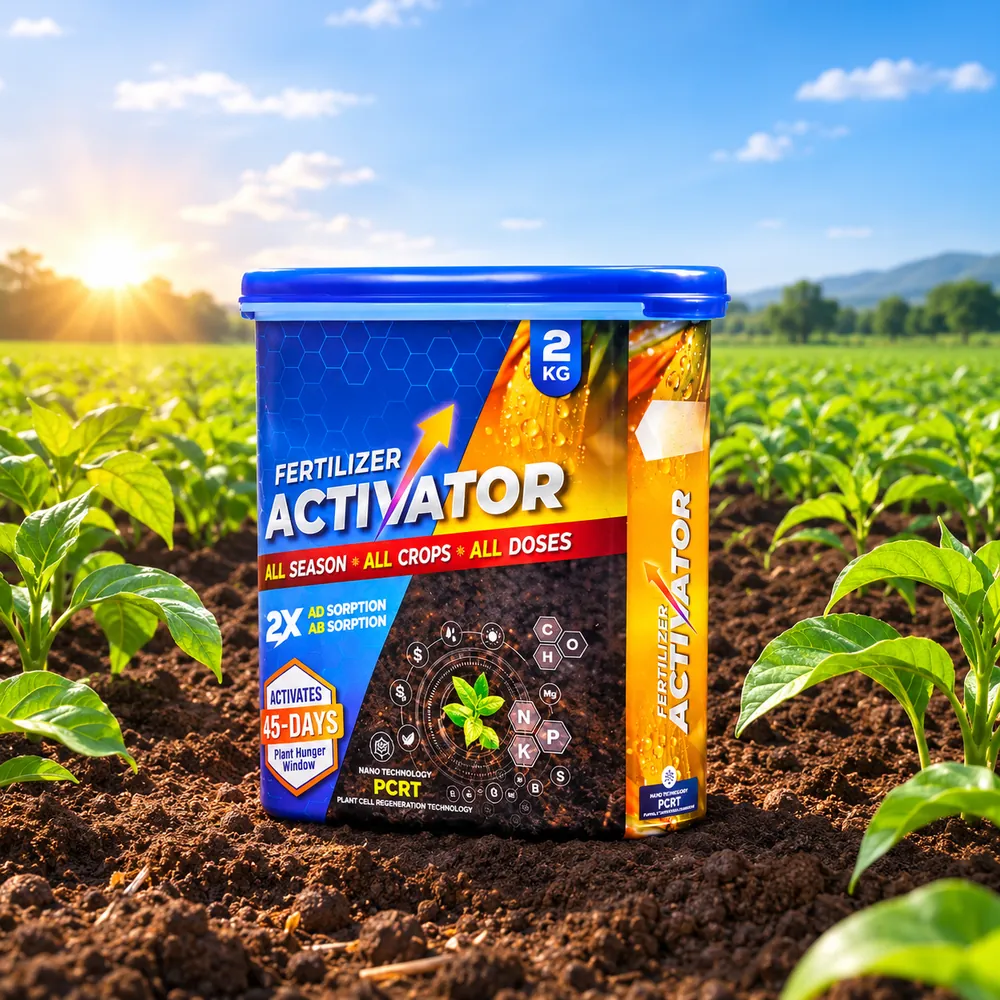
The real problem
Applying fertiliser and the crop using it are not the same thing. Indian research shows a large share of applied nutrients is not used by the crop in the season it is applied.
Reported for Indian agriculture by ICAR scientists (2025).
Source: B. P. Meena et al., “Smart nutrient management practices for sustainable crop production”, Indian Farming 75(12): 32–36 (ICAR, 2025), which reports crop use of N 30–50%, P 15–20%, K 50–80% and micronutrients below 5%. The “not used” shares are the remainder. Read the article ↗
Not immediately used by the crop, from the Ministry's reply published on 10 March 2026.
| Nutrient | Not used |
|---|---|
| Nitrogen (N) | 55–70% |
| Phosphorus (P) | 75–85% |
| Potassium (K) | 40–50% |
From the use efficiencies of N 30–45%, P 15–25% and K 50–60% in the PIB release; it gives no micronutrient figure. PIB, 10 March 2026 ↗
Where the rest goes
Each one depends on the nutrient, the soil and the season. None of them takes a fixed percentage on every farm.
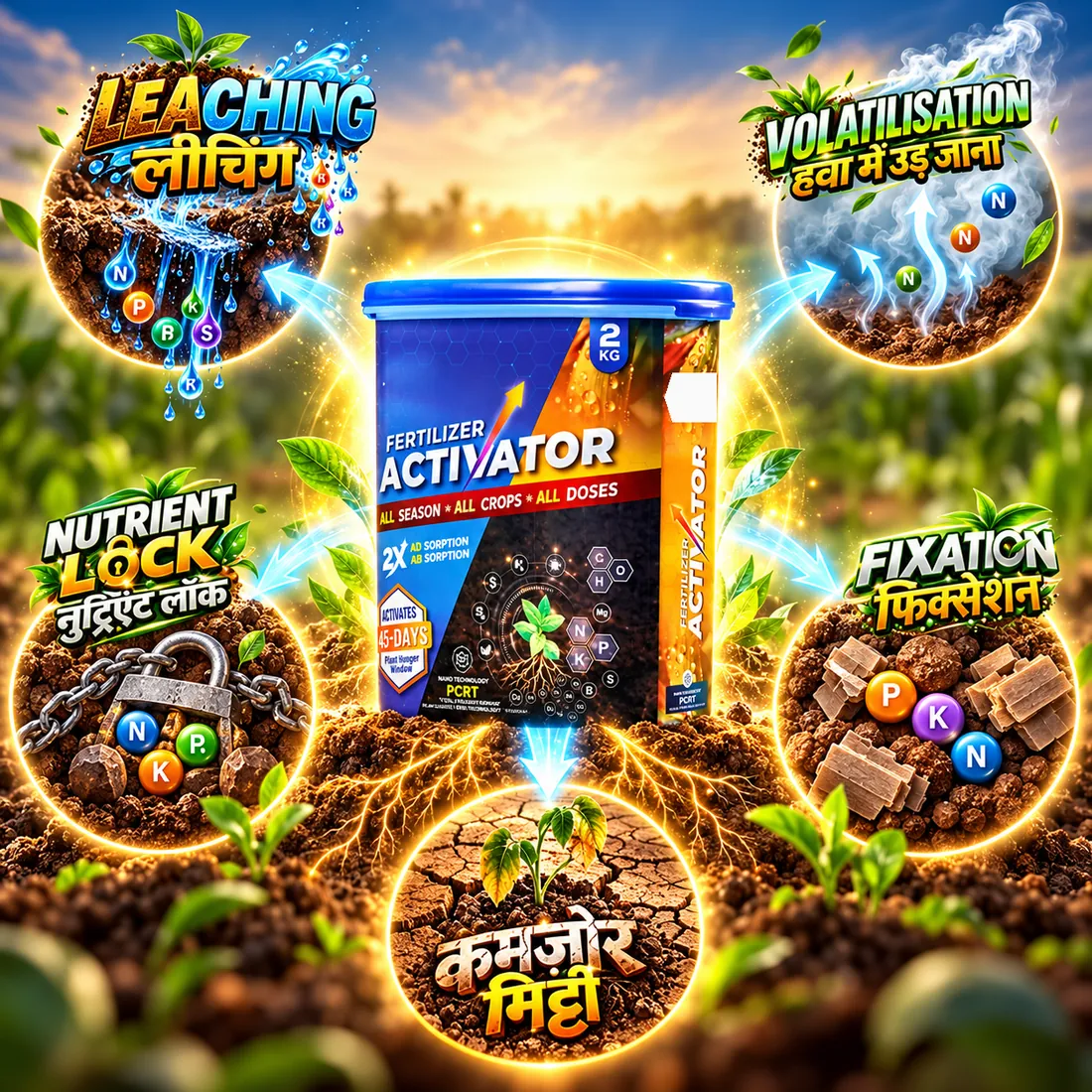
Mobile nutrients such as nitrate move below the roots with excess water, most in light soils and heavy rain.
Urea on the soil surface can lose some nitrogen as ammonia gas, especially in hot, moist conditions.
Rain and irrigation water can carry nutrients and soil away from the field.
Phosphorus and micronutrients react with soil minerals and become harder for roots to reach. Some is released later.
Part of what the crop does not use stays in the soil and can feed the next crop.
Roots under stress, or too few fine feeder roots, cannot take up nutrients that are right there in the soil.
The part you can influence most directly is the root zone: keeping nutrients near active roots, and keeping those roots working. That is what Fertiliser Activator is designed around.
The technology
Fertiliser Activator brings together four NanoKheti technology concepts. It complements your fertiliser programme; it does not replace it.
Plant Cell Regeneration Technology. Focused on root function and new fine feeder roots, the roots that explore the soil for water and nutrients.
Nutrients holding on to soil surfaces in the root zone, so more of them stay where roots can reach them.
Roots taking up the nutrients that are available and moving them into the plant for growth.
Our concept of keeping roots active and feeding for a longer stretch after a fertiliser dose, instead of a short burst.
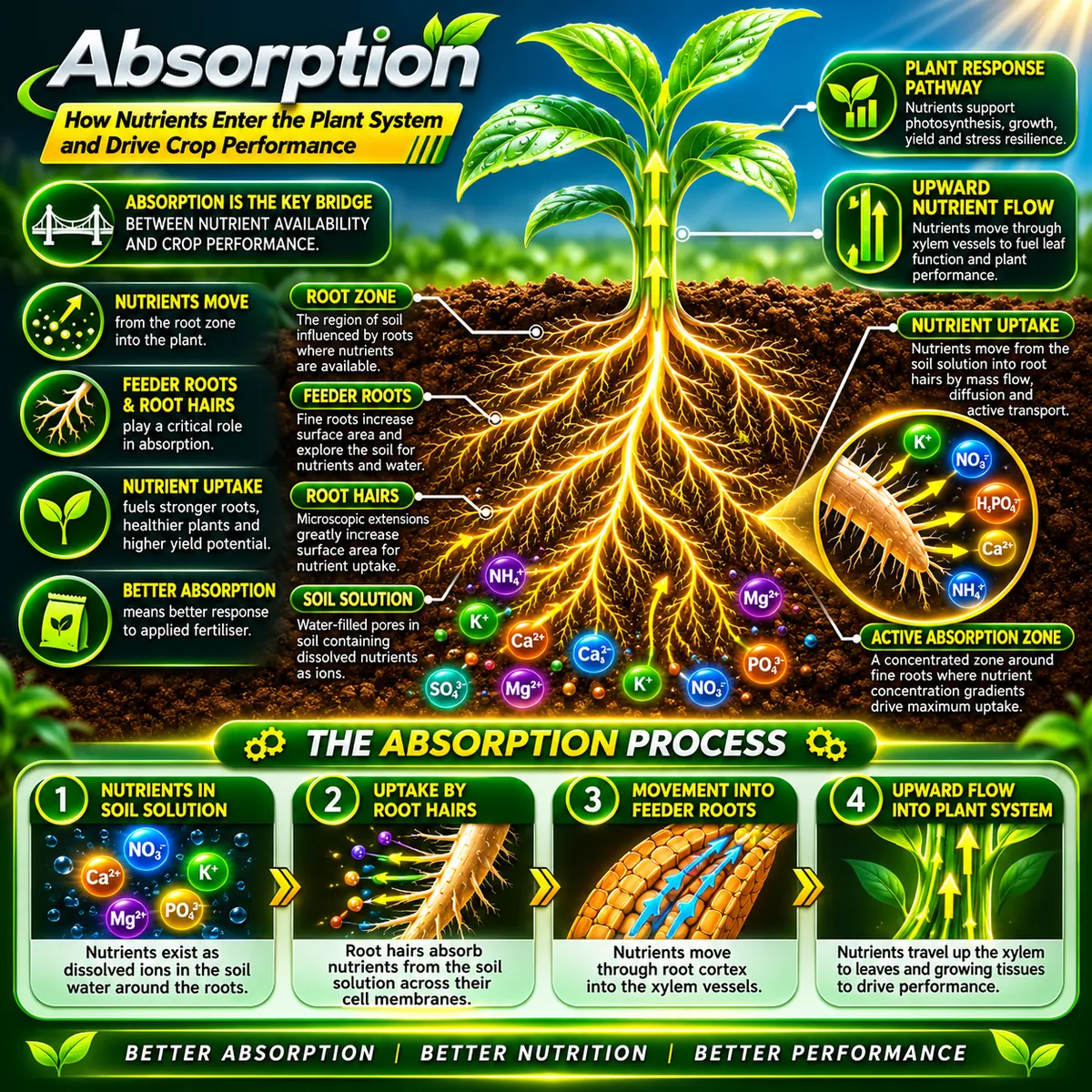

These are NanoKheti's own technology concepts. They describe what the product is designed to do. They are not a promise of a fixed percentage, a fixed number of days or a fixed yield in every field.
From the field
First-hand accounts from farmers who used Fertiliser Activator. They are real experiences, not controlled trials, and we label them that way.

Chetan Khanderao Aher, Kadwa Mahalungi, Dindori, Nashik, Maharashtra · planted July 2025, last harvest 10 January 2026
“Because of Fertiliser Activator I harvested 52 tonnes (2,600 crates × 20 kg) of tomato from 1 acre. My cost came down from ₹1,00,000 to ₹70,000, and the plot's life went from 4 months to 6 months.”Chetan Aher, in his own words (translated from Hindi). His usual harvest in earlier seasons was about 1,500 crates per acre. Contact: 90227 85839, shared with his permission.
He gave Activator about 25 days after transplanting, through his drip system together with 13:40:13, alongside his regular fertiliser schedule. These are his reported figures, comparing this season with his earlier seasons, not a treated and an untreated plot side by side. Weather, variety and crop care also play a part, and results on other farms will differ. Soil application is the main method; drip works only after filtering (see How to use).
Burhanpur, Madhya Pradesh
White roots, more vigorous growth, wider and greener leaves.
Sangola, Solapur
White roots within about 10 days; greener, larger leaves.
Nevasa, Ahilyanagar
After about 15 days: white roots, greener leaves, stronger plants.
Karmala, Solapur
Strong stems, white roots and good colour.
Rajnandgaon, Chhattisgarh
White roots, good colour, uniform curds forming.
Pali, Rajasthan
White roots, larger greener leaves and more branching.
Sabarkantha, Gujarat
Uniform growth, flowering and fruit set, white roots.
Khanapur, Akola
Healthy vines and flowering after heavy rain.
Observations farmers shared with us after using Fertiliser Activator. Not controlled trials; results vary with soil, crop, weather and care.
How to use
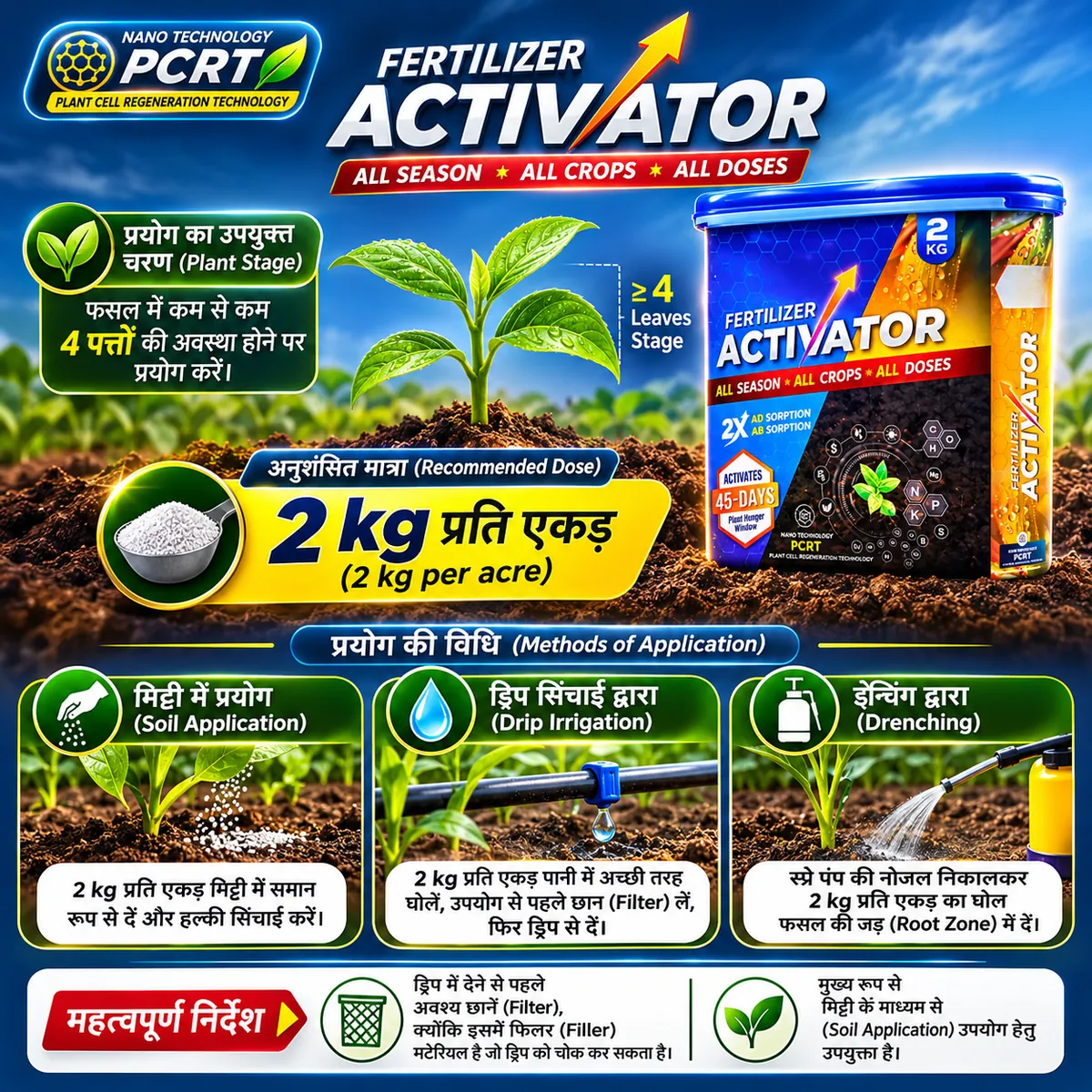
The label on the pack is the final word. This is our current advice for the 2 kg pack.
Use it on a standing crop once it has at least four established leaves.
Take one 2 kg pack for one acre.
Soil application is the main method. Drip or drenching also work, as shown below.
Spread 2 kg evenly over one acre, or mix it with the fertiliser you are applying, in the root zone. Then give a light irrigation.
Dissolve 2 kg (one acre) well in water and filter it before use, then run it through the drip.
Take the nozzle off your spray pump and pour the 2 kg-per-acre solution at the root zone of the crop.
Order
Fertiliser Activator, 2 kg pack for one acre: soil application (main method), drip or drenching.
Dealers and distributors: call 70384 48078 (valid GST and fertiliser licence needed).
Cash on delivery at MRP. Prefer to talk? 91721 16788
Questions
Straight answers, without guaranteed results or inflated loss figures. Still unsure? Ask us on WhatsApp.
A NanoKheti product made to help your crop use more of the fertiliser you already apply. It goes to the root zone, mainly through the soil, and works around the roots: keeping nutrients near them and supporting active feeder roots and uptake.
No. Fertiliser Activator is not a fertiliser and does not supply those nutrients. Keep your balanced fertiliser programme and your soil test advice. Do not cut recommended fertiliser doses because of any promotion.
One 2 kg pack for one acre. Follow the label on the pack.
On a standing crop, once it has at least four established leaves, in the root zone.
Soil application is the main method: spread 2 kg evenly over one acre (or mix it with the fertiliser you are applying) in the root zone and give a light irrigation. Drip irrigation and drenching also work; see the next two answers.
Yes, with care. Dissolve 2 kg (for one acre) well in water and filter it before it goes into the drip: the pack contains filler material that can choke drip lines and emitters. Soil application remains the main method.
Take the nozzle off your spray pump and pour the 2 kg-per-acre solution at the root zone of the crop.
No. It is made for the soil and the roots, not for foliar spray.
It is a NanoKheti concept: keeping roots active and feeding for a longer stretch after a fertiliser dose, instead of a short burst. It describes what the product is designed for; it is not a promise that every crop feeds for exactly 45 days.
Adsorption is nutrients holding on to the surface of soil particles, near the roots. Absorption is the root taking nutrients in. Holding nutrients in the soil and taking them up are two different steps; a crop needs both.
No. The research figures on this page describe nutrient use in Indian agriculture in general. They are not trial results of this product and do not endorse any product.
Nobody can promise that. 52 tonnes is one farmer's reported harvest. Yield depends on variety, weather, soil, water, crop care and the rest of the nutrition programme.
₹1,099 for the 2 kg pack (MRP, also the cash on delivery price), or ₹989 when you pay 100% online. Delivery is free on orders above ₹999.
Sources
How we write this page: we keep published research, NanoKheti's own technology concepts and farmer reports apart, and we do not present general research as proof or endorsement of our product.